Unions Propose 7.5–9.5% Minimum Wage Hike for 2027
The Indonesian Trade Union Confederation (KSPI) and the Labor Party have formally proposed raising the 2027 minimum wage by 7.5 to 9.5 percent. The proposal was announced by KSPI and Labor Party president Said Iqbal during an online press conference on Tuesday (10/13/2026), ahead of the government's scheduled wage determination.
"The labor proposal for the 2027 minimum wage increase ranges from 7.5 to 9.5 percent. The calculation basis is clear," Said Iqbal said. He stressed the figure follows the formula in Government Regulation (PP) No. 49 of 2026 on wages.
Alongside the range, KSPI is demanding the government set the provincial minimum wage (UMP) and the provincial sectoral minimum wage (UMSP) precisely on November 1, 2026, and ensure sectoral wages stay above the regular minimum in the same region.
The Formula: 3.2% Inflation and a 0.9 Index
Said Iqbal said the 7.5–9.5 percent range is backed by hard numbers. KSPI's calculation uses year-on-year data from October 2025 to September 2026: average national inflation of 3.20 percent and average economic growth of 5.43 percent, with the "certain index" set at 0.9 — the upper limit in the wage formula. The result implies a national average increase of around 7.8 percent.
Said stressed the increase cannot be uniform across regions, since each province and regency or city has different inflation and economic growth rates.
Coordinated Rallies Across 38 Provinces, October 15–30
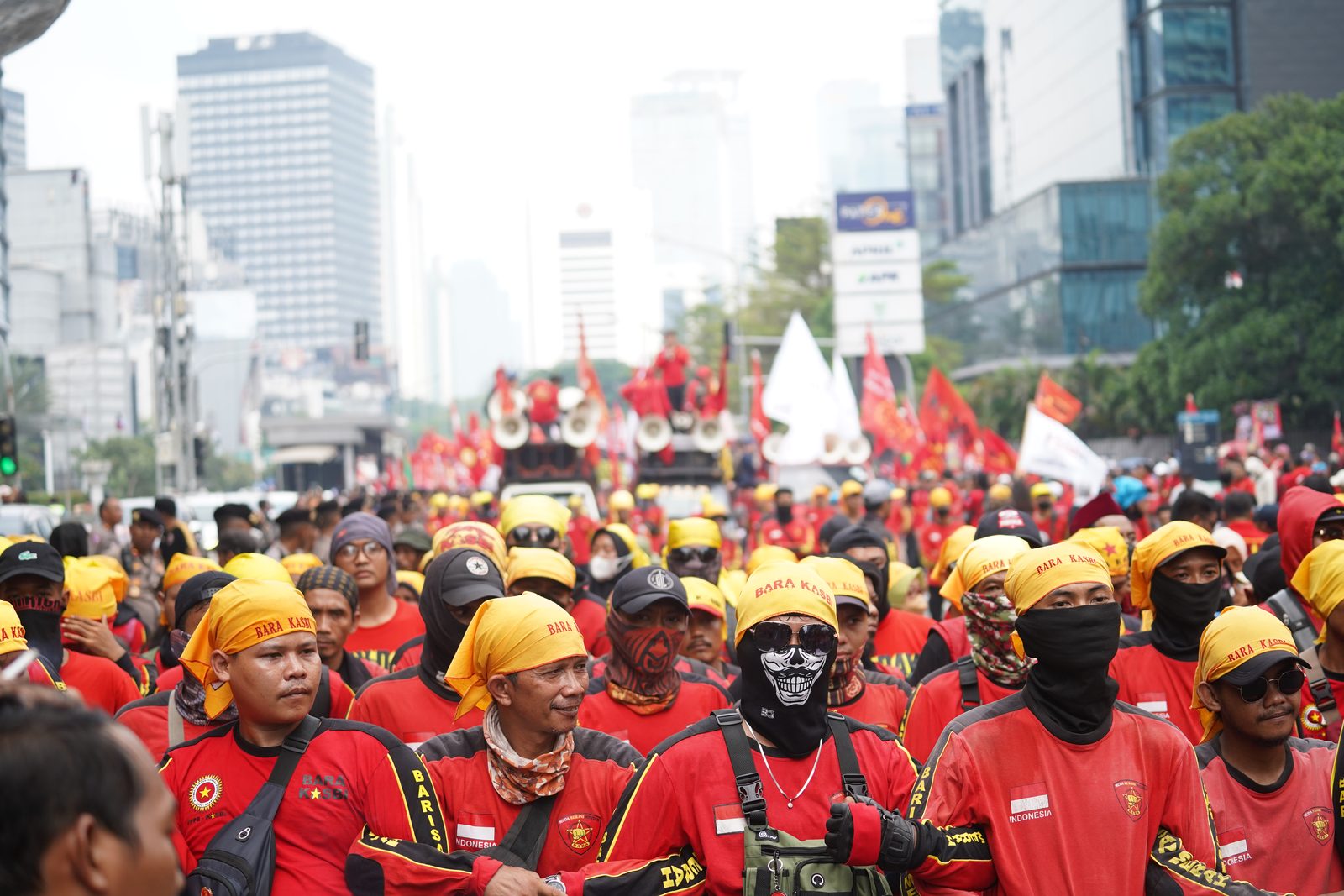
To back the demand, KSPI and the Labor Party are preparing rolling demonstrations across 38 provinces from October 15 to 30, 2026, targeting regional government offices to oversee local wage formulation — including ensuring that regent and mayor recommendations on sectoral wages are honored by provincial governments.
Beyond wages, the rallies will also push for limits on outsourcing and changes to severance schemes in line with the newly passed labor law.
For comparison, Malaysia has set a 17.6 percent minimum wage increase for June 2027 — well above what Indonesian unions are proposing.
Employers Push Back, Cite Productivity
The proposal drew an immediate response from employers. The Indonesian Employers Association (APINDO), through labor affairs chairman Bob Azam, said a 9.5 percent UMP hike must be matched by productivity gains — Indonesian worker productivity is estimated at just 3 to 4 percent.
APINDO proposed capping the alpha index at 0.1 to 0.3 for labor-intensive industries, citing Vietnam, which raised wages 7.2 percent in line with 8 percent economic growth and 10 percent productivity.
Said Iqbal rejected the notion that higher wages automatically trigger mass layoffs. "The minimum wage increase goes hand in hand with productivity gains and lower overhead costs," he said. He cited KSPI records from 2025 through June 2026 showing the factories that closed most were actually in low-wage regions.
According to Said, pressure on labor-intensive industries stems more from other factors: falling demand from international markets, rising raw material and industrial gas costs, and high logistics expenses. Export-oriented textile, garment, and footwear industries have been hit hardest by the global slowdown.